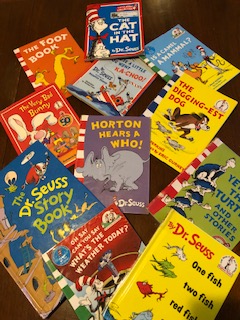
Photo: author’s own texts
What can we learn from Dr Seuss about the teaching of reading?
Teachers love or hate Dr Seuss books, however the fact remains over 600 million copies of Dr Seuss books have been sold across the world, and this number continues to grow every day. They have been translated into more than 20 languages, evidence that many children, world-wide, continue to learn to read with a helping hand from Dr Seuss (Ishizuka & Stephens, 2019). Dr Seuss books have spanned the generations as favourite tomes for parents to share at bedtime, and for children to practise their developing reading skills, inviting multiple reads.
Theodor Geisel, the person behind the Dr Seuss pseudonym, was a children’s book author and illustrator, who was charged with the task of writing a series of basal readers for young children that engaged them in early reading, and made them want to keep on reading. The Sally, Dick and Jane series of basal readers (Smith, 1965) were becoming lacklustre and needed to be replaced (Biography, 2020; Hershy, 1954).
Those teachers who dislike Dr Seuss talk about the heavy reliance on rhyme, and “stuff and nonsense” content, referring to the whimsical, quirky creatures and “out of this world” storylines in the Dr Seuss texts. We hear much the same argument presented in relation to decodable texts (Hoffman, et al., 2002). Decodable texts are the simplest form of continuous texts where the focus is on introducing sounds sequentially to help children practise the alphabetic code, not specifically on making meaning. That said, many “decodables” do have storylines. Most, however, comprise mainly simple sentences linked to form a cohesive text. They are a tool for early readers to practise their emerging phonics knowledge. The Dr Seuss classic collection of basal readers, known as the Beginner Books, are loosely graded. The initial get started level contains 3 texts, the gaining confidence level contains 21 texts; and the take offlevel comprises 10 texts, each level increasing in vocabulary and sentence complexity (Dr Seuss, 1957, p62). This series is but a small part of the entire Dr Seuss legacy, which contains over 60 books.
Conversely, why do so many people love Dr Seuss? Over 600 million books have been shifted in 17 languages and 95 countries, and they have grown in popularity over the years. It has been estimated that more than 450 000 books have been sold since the death of Geisel in 1991 (Ishizuka and Stephens, 2019 p2). Like “decodables”, the Dr Seuss beginner books also provide opportunities for students to practise their decoding skills and growing phonics knowledge. The texts are creative and colourful, mirroring the illustrative style of the author and illustrator, Theodore Giesel. The graphics and content are engaging and fun. Many stories depict naughty, defiant, disobedient characters (some humanoid, some not) who get up to mischief, what most children love to do. Parents and grandparents, many of whom feel a familiarity and nostalgia sharing Dr Seuss with their offspring, feel “at home” amongst books that they also loved as children. Dr Seuss books have spanned generations of early readers.
That said, some Dr Seuss titles have reached their use-by date. What may have been acceptable in the past in children’ literature is no longer acceptable by today’s standards. The company that owns Dr Seuss Books, Dr Seuss Enterprises, announced that they will cease publishing six titles which contain racist imagery and stereotypes that have no place in today’s children’s literature. Two of the books that have been withdrawn from sale are And to Think That I Saw It on Mulberry Street, Geisel’s initial text, and If I Ran the Zoo. Reasons provided by the company are that they “portray people in ways that are hurtful and wrong.” The books have been criticised for racist illustrations and content (NPR, March 2, 2021). The other titles to be permanently removed from sale include McElligot’s Pool, On Beyond Zebra!, Scrambled Eggs Super! and The Cat’s Quizzer.
Opinion is divided in relation to the removal of these texts from circulation – both online and in print. On one hand, people see the move as yet another example of political correctness gone mad, an example of “cancel culture” (Fine, 2021; Steger, 2020), comparable to the uproar during James Cook’s 250 year celebrations in 2020 over whether Captain Cook’s statues should be removed throughout Australia. We now see another side to this sainted national hero (FitzSimons, 2020; Grant, 2020). When viewed through a contemporary lens, history does not measure James Cook well.
Juxtaposed to this “cancel culture” view is one that Theodore Geisel, in the guise of Dr Seuss, continues to make a significant contribution to children’s literature, as book sales attest, albeit one that has been nuanced to reflect what is obligatory in today’s world (Pratt, 2021; Harris, 2021). No longer do we accept racist and sexist illustrations and or content in books. Geisel’s significant body of work has been trimmed by the gatekeepers, to ensure that the many and varied positive messages of moral inspiration from Dr Seuss, “Seuss-isms” (Dr Seuss Enterprises, 2015), live on to continue to encourage children to achieve goals, build a love of the ebb and flow of the written word and view reading as a fun thing to do, something they strive to excel at. The times are a- changing, and the decision to remove these titles from the Dr Seuss collection reflect this world-view, to ensure children’s literature is inclusive and representative of the multicultural societies in which we live.
References
Biography. (2020). Dr Seuss: the story behind the cat in the Hat. Retrieved https://www.biography.com/news/story-behind-dr-seuss-cat-in-the-hat
Dr Seuss Enterprises. (2015). Seuss-isms! A guide to life for those just starting out… and those already on their way.Harper Collins.
Grant, S. (2020). Between the ship and the shore: The Captain James Cook I know. Sydney Morning Herald (SMH), Opinions. April 28, 2020. Retrieved
Fine, D. (2021). Dr Seuss not cancelled: old stereotypes are being made redundant. Sydney Morning Herald (SMH), Opinions. March 4, 2021. Retrieved https://www.smh.com.au/culture/books/dr-seuss-not-cancelled-old-stereotypes-are-being-made-redundant-20210304-p577q1.html
FitzSimons, P. (2020). Captain James Cook the man: a dour doer, not a tinsel talker. Sydney Morning Herald (SMH), Opinions. April 26, 2020. Retrieved https://www.smh.com.au/national/captain-james-cook-the-man-a-dour-doer-not-a-tinsel-talker-20200426-p54ncq.html
Harris, M. (2021). Pulling racist Dr Seuss books makes kids literature better and more inclusive. Washington Post, March 5, 2021. Retrieved https://www.washingtonpost.com/outlook/seuss-childrens-literature-diversity/2021/03/05/e2838fdc-7db8-11eb-85cd-9b7fa90c8873_story.html
Hershy, J. (1954). Why Do Students Bog Down on the First R? Life Magazine, May 24, p136. Retrieved https://www.originallifemagazines.com/product/life-magazine-may-24-1954/
Hoffman, J.V., Sailors, M., Patterson, E.U. & The Centre for the Improvement of Early Reading Achievement (CIERA). (2002). Decodable texts for beginning reading instruction: the year 2000 basals. Retrieved https://journals.sagepub.com/doi/pdf/10.1207/s15548430jlr3403_2
Ishizuka, K. & Stephens, R. (2019). The Cat is Out of the Bag: orientalism, anti-blackness, and white supremacy in Dr Seuss’s children’s books. Retrieved https://sophia.stkate.edu/rdyl/vol1/iss2/4
National Public Radio (NPR). (2021). Dr. Seuss Enterprises Will Shelve 6 Books, Citing ‘Hurtful’ Portrayals. March 2. Retrieved https://www.npr.org/2021/03/02/972777841/dr-seuss-enterprises-will-shelve-6-books-citing-hurtful-portrayals
Pratt, M. (2021). Six Dr Seuss books will no longer be published due to racist images. Sydney Morning Herald (SMH), Opinions. March 3 2021. Retrieved https://www.smh.com.au/world/north-america/six-dr-seuss-books-will-no-longer-be-published-due-to-racist-images-20210303-p5778m.html
Salem, L. (2021). Documenting the portrayal of diversity in children’s picture books. Taylor Francis Online. 22 Feb 2021. Retrieved https://www.tandfonline.com/doi/abs/10.1080/01462679.2021.1888834?src=&journalCode=wcol20
Steger, J. (2021). The cancel culture that stole Dr Seuss. Sydney Morning Herald (SMH), Opinions. March 3 2021). Retrieved https://www.smh.com.au/culture/books/the-cancel-culture-that-stole-dr-seuss-20210303-p577hp.html